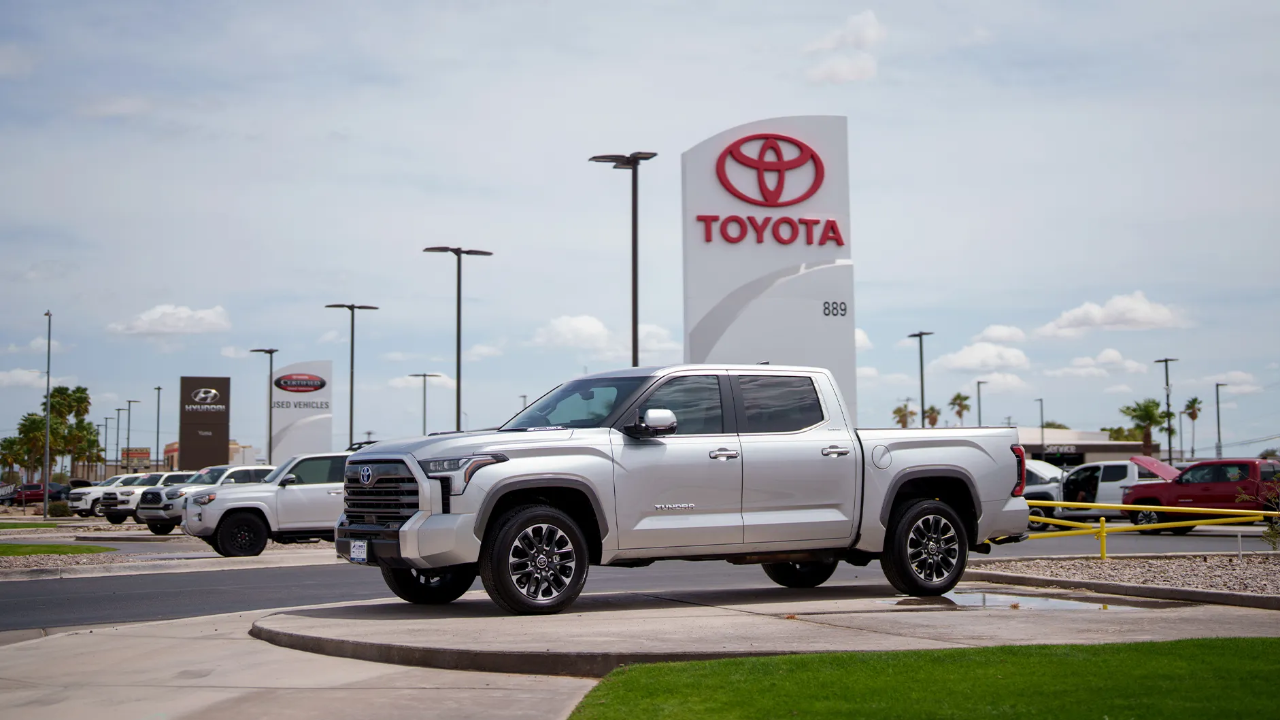
Toyota announced a recall affecting approximately 1,025,000 vehicles across the United States due to a critical software malfunction in the Panoramic View Monitor system’s Parking Assist ECU that can cause backup cameras to fail or freeze when drivers shift into reverse.
This marks one of 2025’s largest automotive recalls, affecting models manufactured between 2022 and 2025. The defect violates Federal Motor Vehicle Safety Standard No. 111, which requires rearview cameras to display images when reversing.
The Electronic Heart of the Problem

The root cause lies within the Parking Assist Electronic Control Unit software that manages Toyota’s Panoramic View Monitor system. Under certain circumstances, the backup camera image may not be displayed or may freeze briefly after being displayed while reversing.
Toyota stated that “if this occurs while the vehicle is being reversed, the vehicle may not meet a federal safety standard, and there can be an increased risk of a crash with a person behind the vehicle”.
Federal Law Meets Digital Reality

Since May 2018, Federal Motor Vehicle Safety Standard No. 111 has required all new vehicles under 10,000 pounds to have functioning rearview cameras. Toyota’s software failure directly violates this regulation, as affected vehicles “may not meet a federal safety standard” when cameras malfunction during reversing.
The National Highway Traffic Safety Administration established these requirements after determining that backup cameras could prevent approximately 210 deaths and 15,000 injuries annually.
The Human Cost of Blind Spots

NHTSA data reveals backover accidents cause approximately 210 fatalities and 15,000 injuries annually, with children under five and adults over 70 most vulnerable. When Toyota’s cameras fail, drivers lose complete rear visibility, creating the exact dangerous conditions federal law aimed to eliminate.
One affected owner, a software developer with a 2022 Lexus NX who runs the YouTube channel LSFT, documented this as his “4th recall and 3rd Limited Service Campaign, totaling 7 dealer trips” for a single vehicle.
A Cascade Across 23 Models and Two Brands

The recall spans Toyota models including the bZ4X, Camry, Crown, Crown Signia, Grand Highlander, Highlander, Land Cruiser, Mirai, Prius, RAV4, Sienna, and Venza. Affected Lexus models include the ES, GX, LC, LS, LX, NX, RX, RZ, and TX.
All vehicles were manufactured between 2022 and 2025 and equipped with the Panoramic View Monitor system containing the problematic software.
The Dealer-Only Fix Exposes Industry Gaps

Unlike Tesla, Ford, or Polestar—which can deploy over-the-air software updates remotely—Toyota requires every affected owner to schedule a dealership appointment for manual Parking Assist ECU software updates. “This is the 4th recall…unlike Tesla, Ford, or Polestar,” noted the LSFT channel owner in his video documenting the recall experience.
Toyota and Lexus dealers will perform the software update at no cost to customers. Owner notifications will be sent by late December 2025.
When Innovation Becomes Liability

Modern vehicles contain over 100 million lines of code—more than a Boeing 787 Dreamliner—creating exponential opportunities for software defects. Software-related recalls surged dramatically in 2024, with one industry analysis reporting that “infotainment and software-driven recalls accounted for 44% of all recalled vehicles” that year.
Automotive expert commentary suggests “every thousand lines of code would possibly introduce 4-6 safety defects into the system,” highlighting the magnitude of quality assurance challenges automakers face.
Regulatory Pressure Intensifies

The NHTSA’s confirmation of Toyota’s violation demonstrates heightened federal scrutiny of automotive software compliance. Transportation Secretary Anthony Foxx stated when announcing backup camera requirements, “We are committed to protecting the most vulnerable victims of backover accidents—our children and seniors”.
The agency has issued increasingly aggressive enforcement actions, including significant penalties for delayed recall reporting.
The Financial Toll of Digital Defects

Automotive recalls cost manufacturers between $500 and $2,000 per vehicle for hardware issues, with software-focused recalls averaging $300 to $500 per unit. Toyota’s 1.025 million-vehicle campaign could generate direct costs exceeding $300-500 million when factoring in dealer logistics, customer outreach, and software development.
These figures exclude reputational damage and potential impacts on future sales. Ford’s 2025 recall challenges have already generated over $5 billion in recall-related expenses, demonstrating the financial magnitude of software quality issues.
Rental Fleets Face Operational Paralysis

Rental car companies and corporate fleet operators with affected Toyota and Lexus models must coordinate mass software updates while managing vehicles that may not meet federal safety standards. Fleet management experts warn that “when your fleet has cars recalled, the vehicles may need costly repairs” and create “severe liability” if recalled vehicles remain in service with known defects.
This creates cascading disruptions for travelers and businesses dependent on rental availability, as affected vehicles require dealer appointments for software updates.
The Dealership Service Surge Begins

Toyota dealerships will absorb a massive influx of recall appointments beginning when owner notifications are mailed in late December 2025. Software updates require dealer service appointments, straining service bays already operating under “increased service visits, vehicle recalls, and ongoing labor challenges”.
Industry research shows wait times for service appointments have “gotten progressively worse since the pandemic and show no immediate signs of easing up,” according to J.D. Power.
Insurance Industry Recalculates Risk

Software defects introduce new variables into automotive insurance risk assessment, with insurers examining quality management systems and update capabilities. One insurance industry analysis noted that software-related issues “now account for up to half of all automotive recalls,” with modern vehicles containing “100 million lines of code” creating millions of potential defects.
Insurers increasingly demand that manufacturers demonstrate robust software quality processes and over-the-air update capabilities.
Canadian Owners Face Identical Dangers

Transport Canada confirmed 99,182 vehicles across multiple Toyota and Lexus models face the same backup camera software failures. The regulatory notice states, “Under certain circumstances, the backup camera image in the subject vehicles may not be displayed or may freeze briefly after being displayed while reversing”.
Canadian regulations require rearview images to display when vehicles are reversing, making this a federal safety standard violation.
Drivers Relearn Pre-Digital Safety Habits

The recall forces drivers accustomed to camera-based reversing to rediscover manual safety checks using mirrors and direct physical observation. Federal backup camera mandates, implemented in May 2018, created expectations that digital aids would enhance safety and eliminate blind spots.
Until repairs are completed, owners must exercise extreme caution when reversing, combining traditional techniques with potentially unreliable camera technology.
The OTA Divide Reshapes Competitive Landscape

Tesla’s ability to deploy software updates remotely to millions of vehicles stands in stark contrast to Toyota’s dealer-visit requirement. Automotive technology reporting notes that “Tesla once issued 42 updates within six months,” while traditional manufacturers “may only release updates perhaps once a year”.
Polestar, Rivian, and Ford’s Mustang Mach-E offer comprehensive over-the-air capabilities, allowing remote software fixes without dealer appointments.
Winners and Losers in the Software Race

Brands with mature over-the-air infrastructure—Tesla, Polestar, Rivian—avoid dealership bottlenecks and demonstrate superior software management capabilities. Traditional automakers reliant on dealer-based fixes face reputational challenges and higher operational costs.
One automotive supplier executive warned that “automakers and their supply chains must awaken to the enduring truth that embedding quality into development demands ongoing dedication”. Consumer trust surveys reveal automotive ranked “lowest among consumer-facing sectors” for reliability, with software failures contributing significantly to this perception.
Market Reaction and Investor Scrutiny

Toyota’s recall announcement prompts analysis of the company’s software development processes and broader electrification strategy. Investors monitor recall costs against Toyota’s EV transition, where software quality increasingly determines competitive success.
Ford’s comparable 2025 recall challenges—costing over $5 billion—resulted in a 7 percent stock decline following the November 2025 supplier fire and projected losses of $5.5 billion in EV and software operations.
What Owners Must Do Now

Affected owners should check recall status using their 17-digit Vehicle Identification Number at Toyota.com/recall or Lexus.com/recall. NHTSA’s database at nhtsa.gov/recalls provides independent verification. Owners can contact Toyota Customer Service at 1-800-331-4331 or Lexus at 1-800-255-3987 for additional questions.
Once notified in late December 2025, schedule dealer appointments promptly for the free Parking Assist ECU software update. Until repairs are completed, exercise extreme caution when reversing, relying on mirrors and direct observation rather than potentially malfunctioning cameras.
Lessons for an Industry in Transition

This recall underscores the automotive industry’s ongoing transformation from mechanical to software-defined vehicles. Industry analysts tracking the surge in software-related recalls note that over-the-air update capabilities are “no longer optional—they’re essential”.
Toyota’s challenge reflects sector-wide struggles with “siloed development between hardware and software teams,” “fragmented supplier ecosystems,” and “inadequate testing for real-world complexity”.
A Wake-Up Call for the Digital Age

Toyota’s recall affecting 1,025,000 vehicles in the U.S. and 99,182 in Canada transcends a routine safety fix—it reveals how software errors cascade through interconnected systems, affecting manufacturers, dealers, insurers, fleet operators, and millions of consumers.
The incident demonstrates that digital defects replicate instantly across entire production runs and continents, bounded only by manufacturing dates and software versions. As vehicles evolve into software-defined platforms, the industry confronts a fundamental question: Can traditional automakers adapt their development processes quickly enough to match software-first competitors?