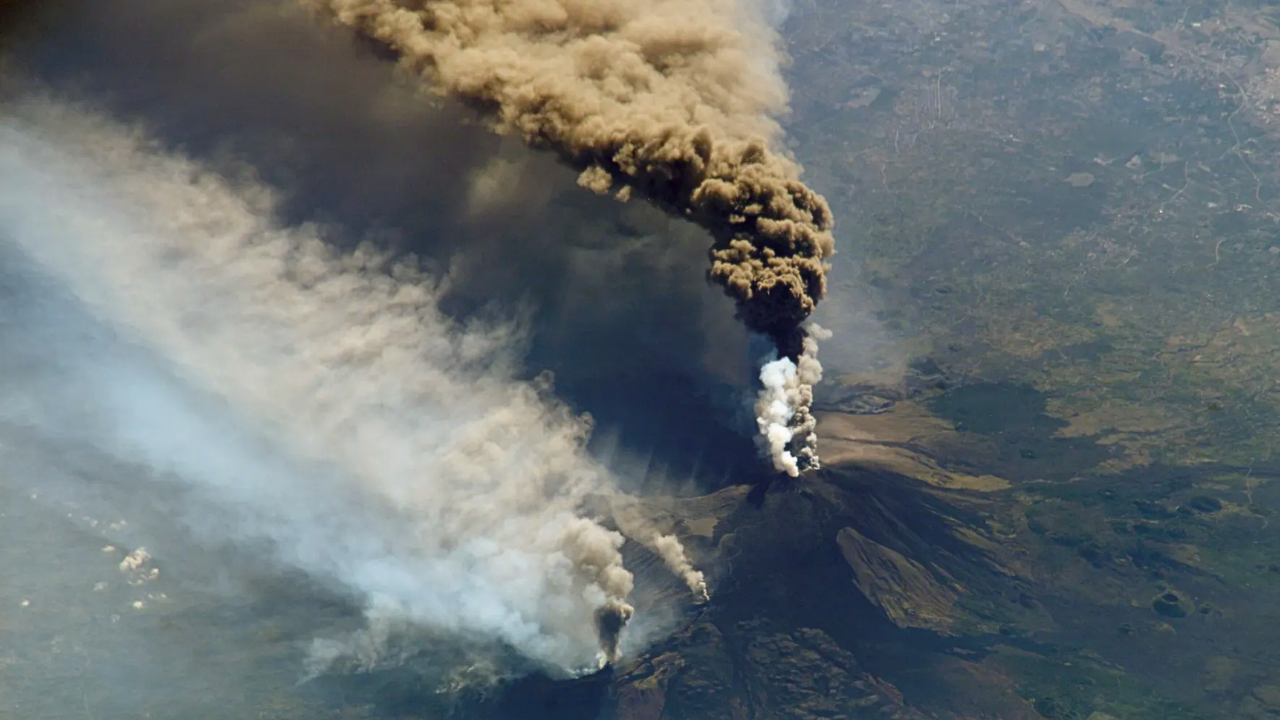
A volcano in Ethiopia that had been quiet since the Ice Age suddenly erupted on November 23, 2025, sending a massive cloud of ash and toxic gas across Africa, the Middle East, and Asia. Hayli Gubbi volcano sits in one of the hottest and most remote places on Earth—the Danakil Depression in Ethiopia’s Afar region.
Scientists had no record of this volcano ever erupting before, and very few monitoring tools watched over it. The explosion happened at 8:30 in the morning and shot ash between 33,000 and 49,000 feet into the sky in less than an hour. Satellites measured around 485 million pounds of sulfur dioxide pouring into the atmosphere—a toxic gas that makes breathing difficult and causes acid rain.
The eruption caught everyone by surprise. A few months earlier, another volcano about 25 miles away called Erta Ale had erupted in July 2025, and scientists from the COMET project warned that hot magma was moving underground through connected chambers.
By mid-November, earthquakes shook the ground near Hayli Gubbi and instruments detected the mountain swelling, but regional warning systems had only minutes to alert people before the main blast. Within hours, the ash cloud crossed the Red Sea and began spreading across multiple countries.
Four Countries Face Breathing Problems and Flight Chaos

The volcanic ash and gas traveled thousands of miles and affected air quality in Yemen, Oman, India, and Pakistan, plus reaching as far as western China. Yemen saw the ash first on November 24, with traces falling near cities like Sana’a and Hodeidah. Health officials told children, elderly people, and anyone with breathing problems to stay indoors and wear masks.
Health workers reported more patients coming in with respiratory complaints at a time when Yemen’s medical system was already struggling. In Oman, the sky turned gray and visibility dropped so much that fishermen found ash covering their boats and livestock refused to eat grass covered in volcanic dust. Port operations slowed down as workers halted cranes for safety.
The ash cloud caused major headaches for airlines within 36 hours. Because volcanic ash can destroy jet engines by melting inside them at high temperatures, aviation authorities ordered planes to avoid huge sections of airspace. Major airlines like Air India, Emirates, and Pakistan International either canceled flights or took longer routes to stay away from the dangerous cloud. Airports in Delhi, Dubai, and Islamabad saw significant delays.
In Delhi, the volcanic material mixed with the city’s already bad winter smog, making visibility even worse. Some schools and construction sites closed temporarily as a safety measure. By November 25 and 26, satellite pictures showed the ash plume had traveled more than 1,864 miles from Ethiopia, reaching China’s Xinjiang and Tibet regions where it still showed up on air quality monitors.
Scientists Warn More Volcanoes Could Erupt

Back in Ethiopia, herders in the Afar region faced serious problems as ash covered their grazing lands and contaminated water sources that now needed treatment before animals could drink safely. Livestock became sick from eating ash-covered plants, and aid groups rushed to provide emergency animal feed. The eruption revealed dangerous gaps in volcano monitoring systems.
Ethiopia had very few earthquake sensors near Hayli Gubbi, and countries across Africa, the Middle East, and South Asia had no formal system for sharing warnings quickly. Scientists now worry that Hayli Gubbi’s eruption signals bigger problems ahead. The East African Rift—a 4,000-mile crack in Earth’s surface stretching from the Middle East down to Mozambique—shows signs that pressure is building beneath many dormant volcanoes at the same time.
Researchers from COMET and the University of Edinburgh warn that other sleeping volcanoes in Kenya, Tanzania, and the Democratic Republic of the Congo might erupt in coming decades. Some scientists think another major eruption in the region could happen within five to ten years, though making precise predictions remains extremely difficult.
The Hayli Gubbi event showed how quickly a forgotten volcano can disrupt health, travel, and livelihoods across entire continents, pushing experts to call for better monitoring networks and faster information sharing between countries to prepare for future eruptions.
Sources:
Smithsonian Institution Global Volcanism Program, Report on Hayli Gubbi (Ethiopia), November 2025
COMET (University of Bristol), Hayli Gubbi Eruption Analysis, November 2025
NASA Earth Observatory, Hayli Gubbi’s Explosive First Impression, December 2025
Nature Geoscience, East African Rift Volcanic Activity Study, December 2025
Scientific American, Hayli Gubbi Volcano Erupts in Ethiopia for First Time in More Than 12,000 Years, November 2025
CNN, Ethiopia’s Hayli Gubbi volcano erupted for the first time in nearly 12,000 years, November 2025