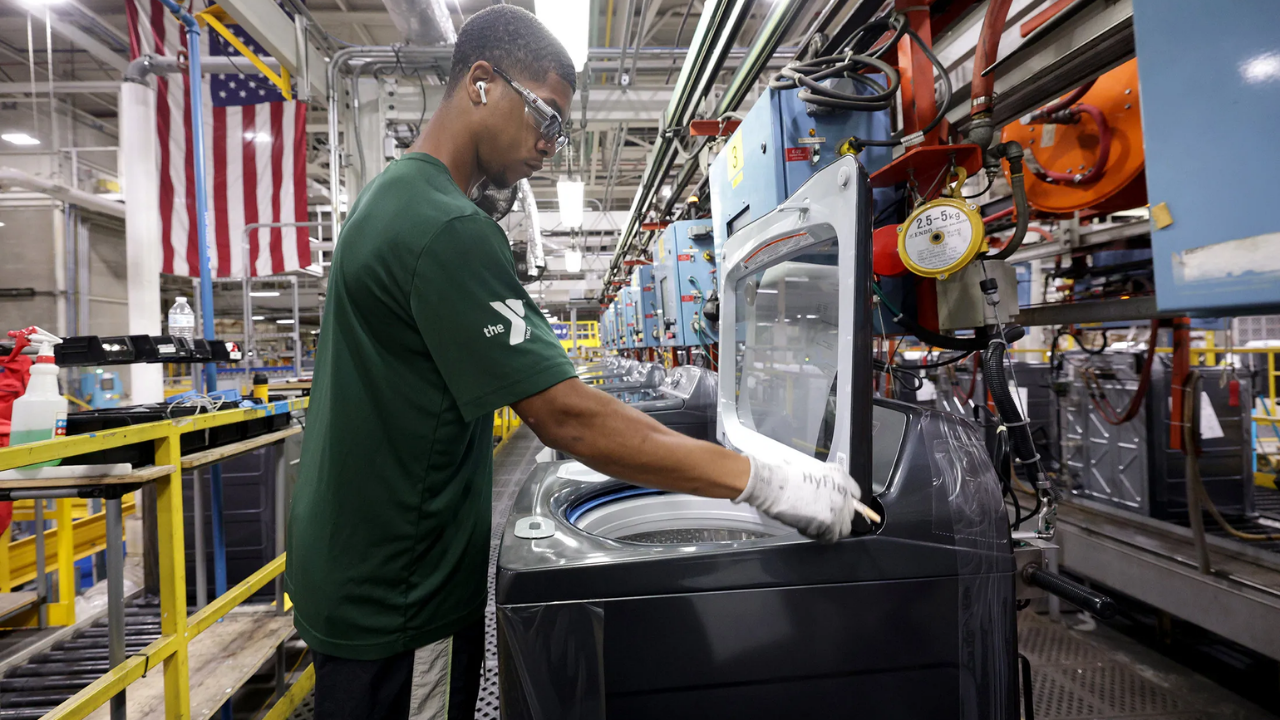
U.S. factories ended 2025 on a weak note, closing out a year-long slump that now spans nearly the entire industrial landscape. The Institute for Supply Management (ISM) said its Manufacturing PMI fell to 47.9 in December, the lowest reading in 14 months and the weakest since October 2024. With any figure below 50 indicating contraction, December marked the tenth straight month of shrinking activity, signaling that manufacturing remains under pressure even as the broader economy continues to expand.
Contraction Deepens and Broadens
Behind the headline number, ISM data show the downturn has become both deeper and more widespread. Roughly 85% of U.S. manufacturing gross domestic product was in contraction during December, up sharply from 58% just one month earlier. Within that, 43% of manufacturing output fell into what ISM classifies as strong contraction, with industry-specific PMIs at or below 45.
The shift suggests that the weakness is no longer confined to a handful of vulnerable sectors. Instead, it has become a broad-based retrenchment across much of factory production, with traditional bellwethers such as transportation equipment, chemicals, fabricated metals, and other core industrial segments all under strain.
Demand, Orders, and Employment Under Strain

The demand backdrop remains weak heading into 2026. ISM’s new orders index came in at 47.7 in December, its fourth consecutive month in contraction and its tenth decline in the past eleven months. Thin order books typically point to subdued output ahead, as production tends to follow demand with a delay.
Survey respondents reported customers postponing purchases or trimming order sizes, reflecting uncertainty over pricing, trade policy, and the economic outlook. New export orders also stayed in contraction, underscoring the challenges facing manufacturers that rely heavily on overseas markets.
Labor conditions mirrored the broader slowdown. ISM’s employment index indicated factory payrolls contracted for the eleventh straight month. Companies described responses such as hiring freezes, curtailed overtime, and cautious staffing decisions, rather than widespread layoffs. Even so, with manufacturing representing roughly 8.3% to 8.5% of total U.S. employment, an extended downturn raises the risk of reduced hours or job losses for a sizable share of the workforce.
Costs Stay High as Prices and Tariffs Bite

The slump in activity has not brought much relief on costs. ISM’s prices-paid index held at 58.5 in December, marking the fifteenth consecutive month of rising input costs for manufacturers. That means many factories are experiencing the difficult combination of falling orders and stubborn cost pressures.
According to survey feedback, higher tariffs, elevated transportation expenses, and supplier pricing power all contributed to persistent inflation in materials and components. Some firms have been able to pass higher costs along the supply chain, but others have been forced to absorb margin pressure in order to keep business.
A strong U.S. dollar added another layer of strain, making American-made goods more expensive abroad and eroding competitiveness against foreign producers. Export-oriented manufacturers, which once could rely on overseas demand to offset domestic slowdowns, now face weaker orders from key markets in Europe and Asia, with higher trade barriers further lifting final prices for international buyers.
Shifting Demand and Spillover Effects

Domestic demand has also shifted in ways that disadvantage factories. Higher borrowing costs and elevated prices prompted many households to pull back on purchases of durable goods such as vehicles, appliances, and home improvement items, while spending more on services like travel and leisure. Manufacturers reported that even aggressive discounting did not fully restore sales volumes amid more cautious consumer behavior.
In response to weaker demand, many factories kept production and inventories on a tight leash. Companies limited output to avoid building excess stock, while customers drew down existing inventories rather than placing new orders. This feedback loop between soft orders, restrained production, and cautious restocking helped prevent a pileup of unwanted goods but also capped revenue growth and prolonged the contraction.
The pain has not been distributed evenly. Industrial regions in the Midwest and South, especially those dominated by autos, machinery, chemicals, and basic materials, are feeling the weight of the downturn. Smaller manufacturers often report less ability to pass on tariff-related costs or negotiate with suppliers, leaving them more exposed to margin squeezes and demand shocks than larger, more diversified firms.
Weakness in manufacturing has carried over into related sectors. Transportation and warehousing have seen fewer shipments and lower equipment utilization, while providers of industrial services and suppliers of raw and intermediate materials have received fewer orders. These spillovers have widened the economic impact beyond the factory floor, affecting logistics providers, maintenance firms, and entire regional supply chains tied to industrial output.
Technology Remains a Rare Bright Spot

Despite the broad softness, one major segment continues to grow. Of the six largest manufacturing industries tracked by ISM, only computer and electronic products remained in expansion territory in December. Demand linked to data centers, artificial intelligence infrastructure, and advanced electronics has supported production and jobs in these areas, even as more traditional sectors contract.
These technology-driven niches benefit from large, long-term capital commitments that are less sensitive to short-term fluctuations in interest rates or consumer demand. Their resilience highlights how structural trends in digitalization and computing are reshaping the composition of U.S. manufacturing, creating a divide between high-growth tech-related production and more cyclical legacy industries.
Looking Ahead to 2026
The December reading underscores how tariffs, financial conditions, and currency movements can interact to intensify pressure on a key part of the economy. With about 10%–10.1% of U.S. GDP tied to manufacturing and 85% of that slice now in contraction, analysts estimate that roughly $2.3 trillion to $2.6 trillion in factory-linked activity is under strain. While much of this production continues, sustained weakness on this scale can ripple into jobs, household income, regional tax bases, and business investment.
Attention now turns to whether policy shifts can help stabilize the sector in 2026. Potential interest-rate cuts and any easing of trade tensions could provide some relief, but manufacturers emphasize that a durable recovery will require a clear and sustained improvement in new orders. At the same time, ongoing input-cost pressures mean factory-level inflation risks could persist even in a cooling economy.
Investors, workers, and policymakers will be watching order flows, pricing trends, and export demand as early indicators of whether U.S. manufacturing can find a floor in the months ahead or faces a more prolonged period of adjustment.
Sources:
Reuters, 2026-01-05Publication: ReutersArticle Title: “US factory sector contracts for 10th straight month in …”
ISM via Supply Chain Dive, 2026-01-05Publication: Supply Chain DiveArticle Title: “US manufacturing activity drops to lowest point of 2025: PMI”
Trading Economics, 2026-01-05Publication: Trading EconomicsArticle Title: “United States Manufacturing PMI”
ARC Advisory Group, 2026-01-06Publication: ARC Advisory GroupArticle Title: “US Manufacturing Activity Remained in Contraction …”
Supply Chain Dive, 2026-01-05Publication: Supply Chain DiveArticle Title: “US manufacturing activity drops to lowest point of 2025: PMI”
ISM via ABA Banking Journal, 2026-01-05Publication: ABA Banking JournalArticle Title: “ISM: Manufacturing sector contracted in December”